My last lesson was predominantly a hack. We did some school work though, which is always super helpful. One thing I’m super glad about is the fact we’re taking more photos and videos, which I have started uploading into AI models.
The lesson itself started off as most do, with tacking up and general chit chat. Very glad to share that the custom polo shirt I made for my coach went down a treat (if you saw my Instagram, you know what I’m talking about).
After a quick tack up and some treats, we headed off. I’m leading the younger horse Apollo more often now, which is giving me great groom experience. One day I hope to get to a club both in the UK and Argentina to trade some work for lessons.
On getting to the green, we did the standard figure-of-eights and leg yielding, both of which I am improving on quite well. The feeling is starting to come to me; not quite so alien anymore.
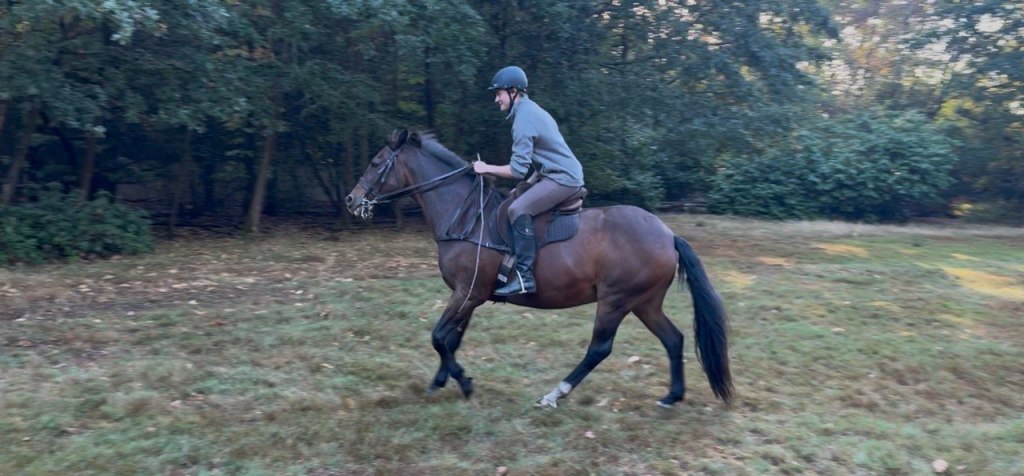
What we have started introducing though is stop-starts. Canter to halt to canter. Based on the picture attached, saying we’re at canter is generous, but trust me—it’s just a bad picture.
As you can see, I am leant quite far forward, my stirrups are very short, and my feet are slightly backwards. The position is what felt most natural and comfortable to me and I think that’s partly what riding is: finding what’s right for you. But, as I work in AI, I thought I would plug in the video and see what it says. Out of curiosity more than anything.
By asking two models that enable video vision (Gemini Pro 3.1 and Gemini 3.8 Flash), I got some insightful feedback. However, there was some confusion on the stirrup length: one model said they were too long and the other too short, so I dove a bit deeper and found out that the recommended stirrup length is in line with your ankle, which led me to dive deeper into correct leg position, and I came up with this:
“With the stirrup sitting just behind the ball of the foot, wrap your entire leg—from thighs to feet—around the trunk of the horse, with about 25% muscle power, and drive the heels down and point the toes out slightly.“
Now, AI is likely never going to replace coaches—at least not for me anyway. Part of what I love about polo—and all sports really—is the social element. Speaking with a person, getting their thoughts, reading their emotions, and sharing your own are all a part of what makes learning so much fun.
In saying that, if I can sit at home and dive deeper into the specifics of my problems, with real feedback on my exact circumstances, then I would be crazy not to. AI is not going anywhere anytime soon and from what I’ve seen, lots of polo pages on Instagram love it. But that’s for another article.
Thank you for reading this article and if you’d like more, drop it a like, or subscribe to get notifications when new ones drop. I try to do one or two a week.
Or, if you’d prefer something a bit more dopamine-triggering, then you can follow my Instagram @SamPlaysPolo where I share more regular updates, stories, and more.

